
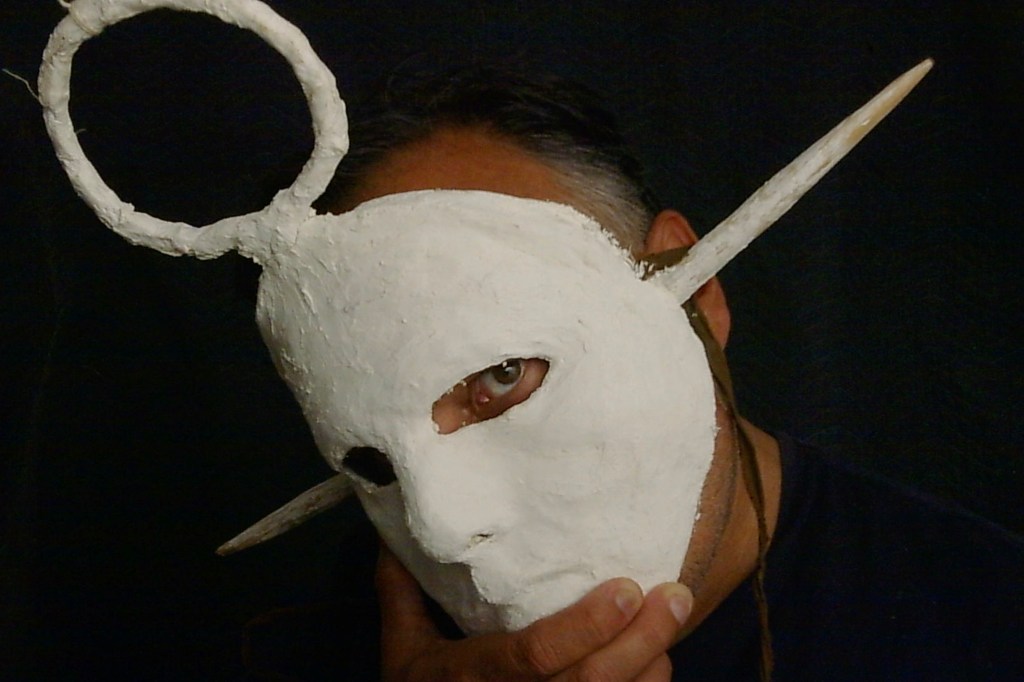
I’m in the middle of writing the second draft of an art film. It is a story rooted in Indigenous experience and perspective. To my surprise, I received a small grant from NB FILM COOP to bring it to life. It’s not just a film, though. It’s a statement. A vision. And the way I’m telling it… let’s just say, it doesn’t follow the usual path.
Without giving too much away, the film challenges consumerism at its core. That’s the irony — I now find myself trying to market it. I’ve started creating “behind the scenes” content on Facebook and YouTube. I am doing this not just to share the creative process. It also serves to generate support and raise funds.
To help with that, I made some T-shirts — my first attempt at turning art into merch. Now I’m stepping into the strange world of branding. I’m learning how to promote a story, a film, an idea — without selling out its soul. Because this film is anti-consumer… and somehow, I have to fund it using the very system it critiques.
Paradoxical? Totally. But maybe that’s part of the trick.
I’m also struggling with the tools themselves — Patreon, YouTube, the website. Each one demands its own format, its own strategy. There’s no “one stop shop.” I wish I could just write something or upload a video and have it ripple across all channels. But instead, every platform becomes its own obstacle. It starts to feel less like storytelling, and more like tech support.
So here I am, facing two big challenges:
- How do I market myself without selling out?
- How do I navigate these platforms without losing creative time?
This blog is part of that journey. Maybe by documenting the process — the friction, the questions, the workarounds — I can stay grounded in the art. I can figure out how to share it.

the anti-consumer consumer product. It has a trickster in there which is actually from this painting.
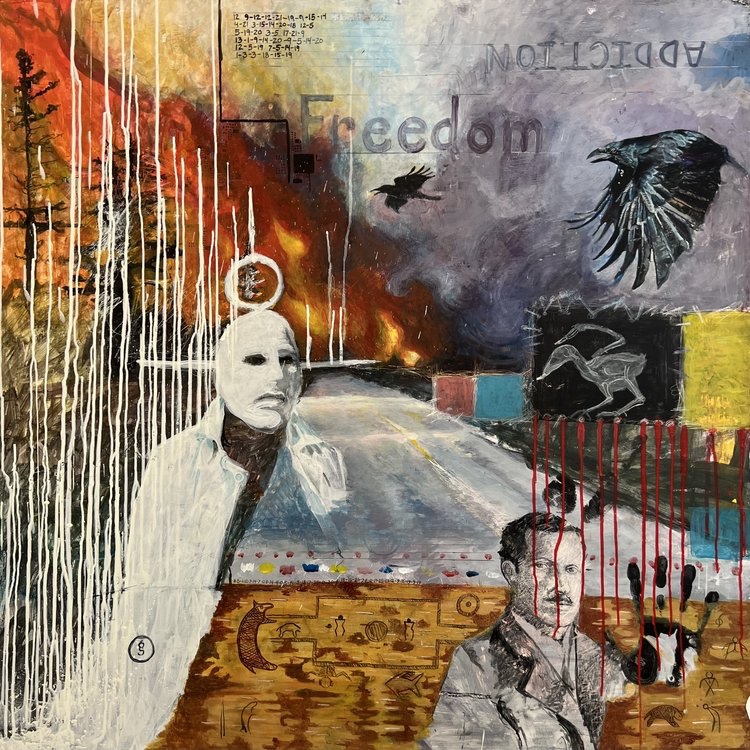
And this painting is an anti consumer painting. I mean it has Edward Bernays in it and a forest fire. He’s the creator of consumerism and manipulated all of us into destroying the planet we depend on.
Edward Bernays was an early 20th-century public relations expert — often called the father of modern propaganda. He was Sigmund Freud’s nephew. He used psychological theories about human desire and fear to manipulate public opinion. His aim was not truth, but selling products and shaping behavior.
In the 1920s, Bernays helped corporations tap into the subconscious, linking products with identity, freedom, sex appeal, and status. For example, he made it socially acceptable for women to smoke by branding cigarettes as “Torches of Freedom.” He didn’t just sell products — he sold lifestyles.
This mindset helped birth consumerism: the idea that buying more = being more. Corporations, using Bernays’ techniques, began shaping our culture around endless consumption — not need, but desire.
Today, that addiction to consumer goods drives overproduction, deforestation, and climate change. Every disposable product, fast-fashion trend, or unnecessary gadget takes resources — often from forests that absorb carbon and stabilize ecosystems. When forests are cleared or degraded, they become drier, more flammable. That’s one way consumer culture contributes to increased wildfires and ecological collapse.
Bernays didn’t start the fire. However, he handed corporations the match. He taught them how to make us want the smoke.
 Once Upon a Time there was an Artist Named Garry Sanipass…
Leave a comment