
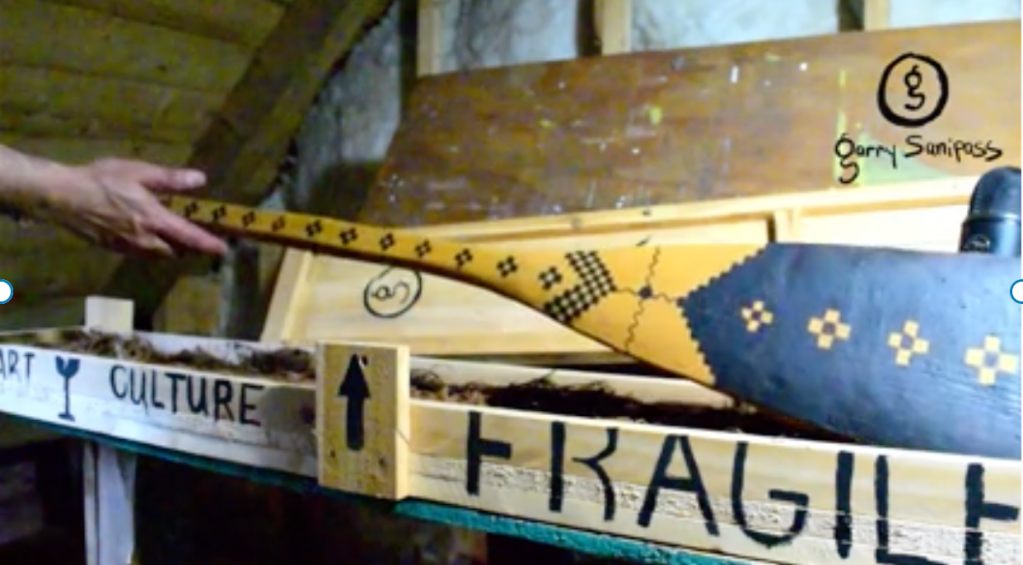
I’ve been working on this idea for a while now. It started with the urge to grind my own pigments—to connect with my ancestors who used the land and its gifts to make tools, paint, and everyday necessities. It also felt like a way to connect with artists of the past, when making your own paints was simply part of the practice.
Along the way, I was inspired by Alan Syliboy and the way he paints on drums. That got me thinking: why not paint on other Indigenous objects—things that already carry story and purpose—like canoe paddles?
The paddle idea was also sparked by my friend John Garfield Barlow, who makes Waltes Games. You should check out his work and keep him busy—he’s a funny guy.
https://www.facebook.com/share/p/18Qtb2Cdf9/
Then I started thinking about packaging. I don’t love the idea of someone leaving a gallery with a piece of work “naked,” vulnerable to the elements. If someone is investing in a handmade artwork, it should be protected. I considered cardboard, maybe a tube—but the more I thought about it, the more that felt off. If the piece is handmade from the pigment all the way to the carved wood, why would I switch gears at the very end with generic packaging?
So I decided to build a shipping-style crate—old-time style. The protective filling is cedar bark. The crate is cedar. Everything is cedar.
And as I painted words and symbols onto the crate, something clicked: the crate and the paddle are related in more than just material. They’re both cedar. They both carry marks and symbols. A shipping crate is meant to travel—eventually it’s loaded onto a ship and transported. A canoe paddle is also made for travel, a tool for moving across water.
There’s something there. I’m not sure exactly what it is yet—but I can feel it.
 Once Upon a Time there was an Artist Named Garry Sanipass…
Leave a comment